Chapter Home Revision Handbook Concept Clarity 20-Second Challenge PYQ Masterclass
APPLICATION MASTERCLASS 11

Calculus Integration

20-Second Physics Challenge
Trigger Recognition & Trap Elimination

Graph Integration

Differentiation tells us how fast a quantity changes.

Integration tells us how much quantity has accumulated.
Slope ↓ Differentiation

Area ↓ Integration

Integration Ladder

Acceleration ↓ Integrate ↓ Velocity

Velocity ↓ Integrate ↓ Position

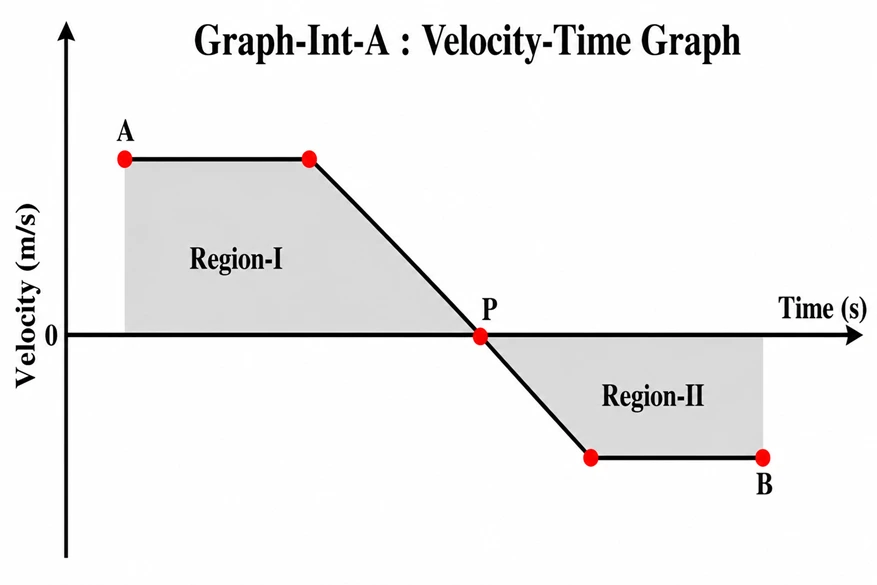
Graph-Int-A : Velocity–Time Graph

Graph Integration A
Key Idea: Area under a Velocity–Time graph represents Displacement.
Displacement = ∫v dt = Area under v–t Graph

Refer Graph-Int-A and answer GIA-01 to GIA-10.

GIA-01

Region-I represents

Correct Answer: A

Trigger

Area Sign

Formula / Tool

Area above axis → Positive displacement

Quick Execution

Region-I lies above the time axis.
Trap: Confusing displacement with acceleration.

GIA-02

Region-II represents

Correct Answer: B

Trigger

Signed Area

Formula / Tool

Area below axis → Negative displacement

Quick Execution

Region-II lies below the time axis.
Trap: Ignoring the sign of area.

GIA-03

If Region-I area is 30 m and Region-II area is 10 m, the net displacement is

Correct Answer: A

Trigger

Net displacement

Formula / Tool

Displacement = Positive Area − Negative Area

Quick Execution

30 − 10 = 20 m
Trap: Adding both areas.

GIA-04

If Region-I area is 30 m and Region-II area is 10 m, the total distance travelled is

Correct Answer: C

Trigger

Distance calculation

Formula / Tool

Distance = Sum of Magnitudes of Areas

Quick Execution

30 + 10 = 40 m
Trap: Using displacement formula.

GIA-05

At point P, the velocity is

Correct Answer: C

Trigger

Axis Crossing

Formula / Tool

Velocity at time-axis crossing = 0

Quick Execution

Point P lies on the time axis.
Trap: Confusing velocity with acceleration.

GIA-06

The particle reverses its direction at

Correct Answer: B

Trigger

Direction Reversal

Formula / Tool

Velocity Changes Sign

Quick Execution

Positive Velocity


Zero Velocity


Negative Velocity
Trap: Choosing the first negative velocity point.

GIA-07

If Region-I and Region-II have equal areas, the net displacement is

Correct Answer: C

Trigger

Algebraic Area

Formula / Tool

Net Displacement = Positive Area + Negative Area

Quick Execution

Equal positive and negative areas cancel each other.
Trap: Adding magnitudes instead of signed areas.

GIA-08

If Region-I and Region-II have equal areas, the total distance travelled is

Correct Answer: B

Trigger

Distance vs Displacement

Formula / Tool

Distance = Sum of Magnitudes of Areas

Quick Execution

Both regions contribute positive distance.
Trap: Assuming zero displacement means zero distance.

GIA-09

The area under a velocity–time graph gives

Correct Answer: C

Trigger

Integration Meaning

Formula / Tool

Displacement = ∫v dt

Quick Execution

Area under v–t graph gives displacement.
Trap: Confusing area with slope.

GIA-10

Distance and displacement become equal when

Correct Answer: C

Trigger

Distance–Displacement Relation

Formula / Tool

No Reversal ↓ Distance = Displacement

Quick Execution

Motion stays in one direction only.
Trap: Thinking velocity must be constant.

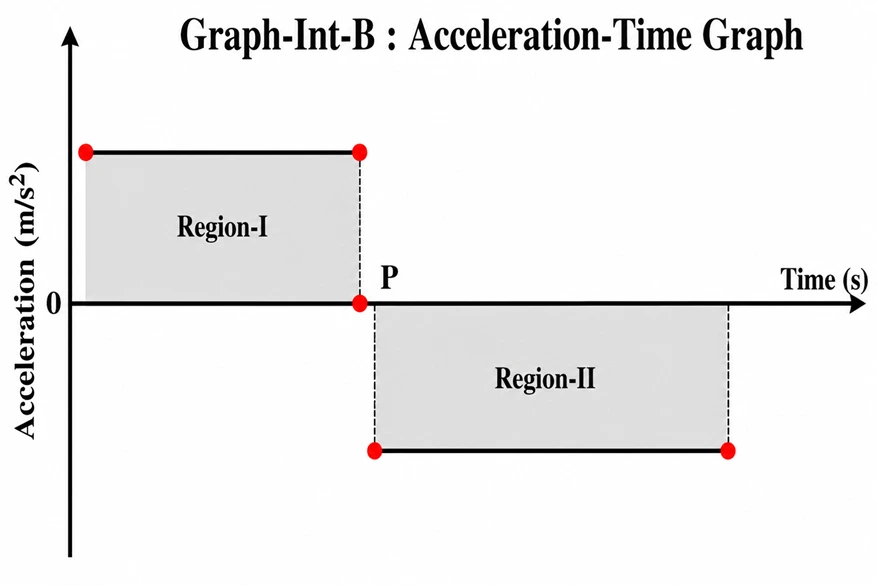
Graph-Int-B : Acceleration–Time Graph

Graph Integration B
Key Idea: Area under an Acceleration–Time graph represents Change in Velocity.
Δv = ∫a dt = Area under a–t Graph

Refer Graph-Int-B and answer GIB-01 to GIB-10.

GIB-01

Region-I represents

Correct Answer: A

Trigger

Positive Area

Formula / Tool

Δv = ∫a dt

Quick Execution

Area above axis gives velocity gain.
Trap: Confusing velocity gain with displacement.

GIB-02

Region-II represents

Correct Answer: C

Trigger

Negative Area

Formula / Tool

Δv = ∫a dt

Quick Execution

Area below axis gives velocity loss.
Trap: Treating all areas as positive.

Graph Integration Master Snapshot

Area under v–t Graph ↓ Displacement

Area above axis ↓ Positive Displacement

Area below axis ↓ Negative Displacement
Area under a–t Graph ↓ Change in Velocity

Positive Area ↓ Velocity Gain

Negative Area ↓ Velocity Loss
Distance = Sum of Magnitudes of Areas

Displacement = Algebraic Sum of Areas

What You Have Learned

Graph Integration Mastery Complete

You can now extract displacement, distance, and change in velocity directly from graph areas.

Instability Analysis

Master zero-velocity states, sign analysis, reversal boundaries, and conceptual traps of motion.