
Imagine watching a train from a platform. At every instant, the train occupies a particular location along the track. As time passes, that location changes. The train may move slowly, rapidly, uniformly, or irregularly. Yet the most direct description of what is happening is simply this: the position of the train is changing with time.
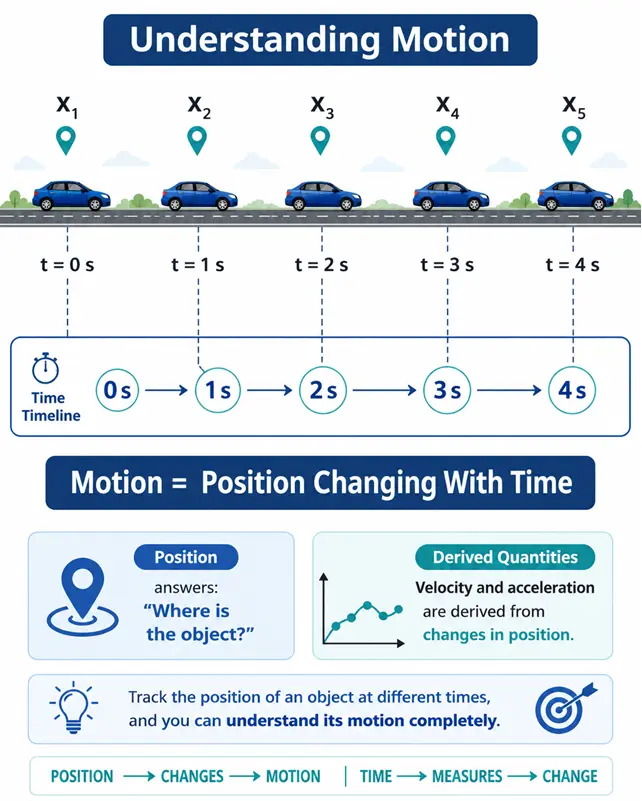
Imagine marking the position of a moving object every second. The collection of these positions forms the complete story of its motion. Once the position at every instant is known, every other kinematic quantity can be obtained from it.
Suppose someone tells you that a car is moving with a velocity of 20 m/s. Have they completely described the motion?
Not really. The car could be at the start of the road, near the destination, or somewhere in between.
Velocity alone does not tell us where the object actually is.
Now suppose someone tells you the acceleration. Again, you still do not know the location of the object.
This suggests that velocity and acceleration are important, but they cannot independently describe motion.
Motion is fundamentally the change of position with time.
Position answers the question: "Where is the object?"
Once position is known as a function of time, velocity naturally emerges from the rate at which position changes.
Acceleration then emerges from the rate at which velocity changes.
Thus the hierarchy of kinematics is:
Position → Velocity → Acceleration
Position is the foundation. Velocity and acceleration are derived quantities.
The mathematical structure of mechanics itself reveals the hierarchy.
Velocity is obtained from position. Acceleration is obtained from velocity.
Therefore the complete description of motion begins with position as a function of time.
Strengthen understanding through practice.