
Throw a ball vertically upward. As it rises, its speed gradually decreases. Eventually it reaches its highest point.
At that instant, the ball appears to stop. Its velocity becomes zero.
Yet immediately afterwards, the ball starts moving downward.
This raises an important question: If the velocity is zero at the highest point, what causes the ball to start moving again?
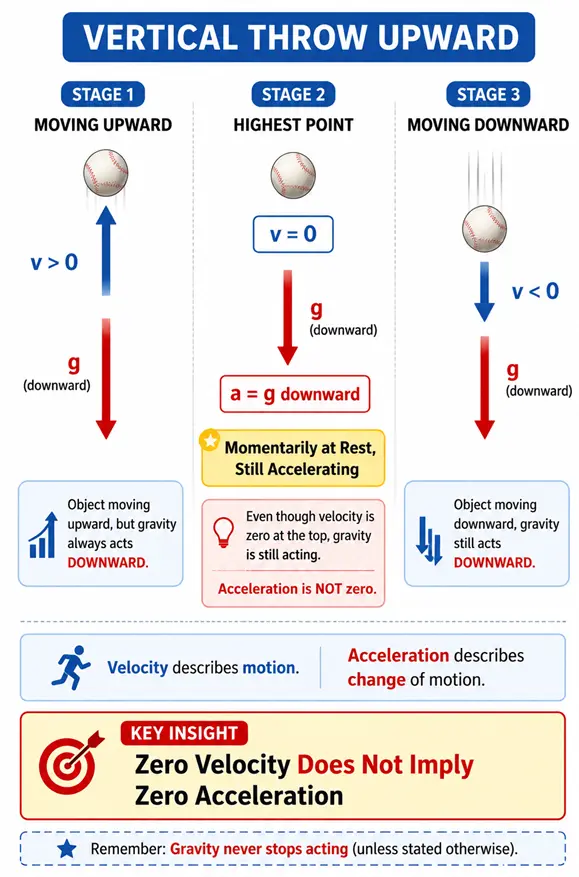
At the highest point of the trajectory, the ball is momentarily at rest.
However, gravity continues to act downward. Therefore the ball immediately begins accelerating downward after that instant.
Suppose acceleration meant "how fast an object is moving."
Then whenever velocity became zero, acceleration should also become zero.
But the ball at the highest point clearly does not remain suspended in air.
Something is still changing.
That "something" is velocity itself.
Velocity describes the state of motion of an object at a particular instant.
Acceleration describes how that state is changing.
These are fundamentally different ideas.
An object may have zero velocity at an instant, yet its velocity may still be changing at that very moment.
At the highest point:
Therefore acceleration remains present even though velocity is zero.
Acceleration is the rate of change of velocity.
Notice that the equation does not say:
Acceleration depends on velocity itself.
It depends on how velocity changes.
Thus,