
2 min read
Imagine a motorcycle travelling behind a car on a long straight highway.
The motorcycle is moving.
The car is also moving.
From a distance, it appears that the motorcycle is continuously chasing the car.
Yet hour after hour, the gap between them never changes.
How is that possible?
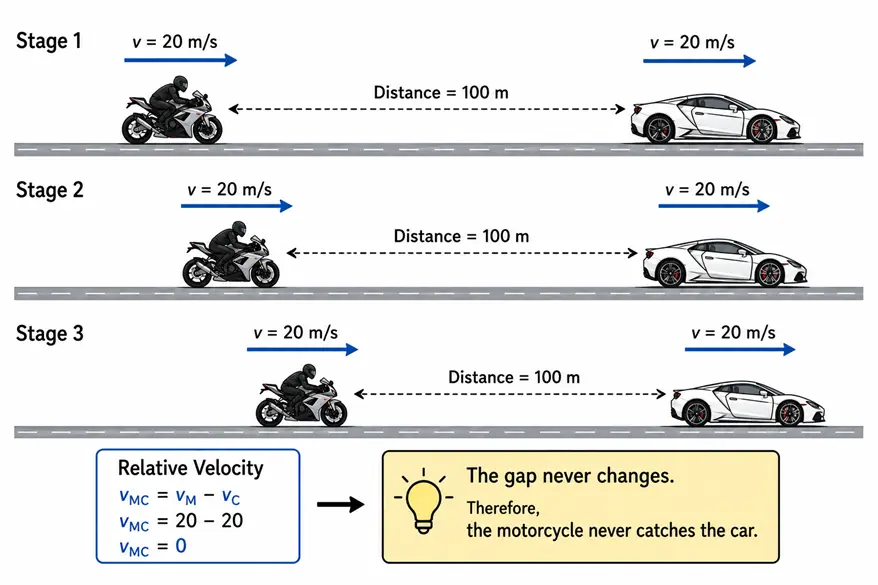
Both vehicles are moving forward.
The motorcycle appears to be pursuing the car.
However, appearance can be misleading.
The important question is not:
"Are they moving?"
The important question is:
"Is the gap changing?"
Suppose the car moves at:
The motorcycle also moves at:
Initially, the motorcycle is 100 m behind the car.
After one second, both vehicles move forward by the same distance.
After ten seconds, both vehicles have again covered exactly the same distance.
The separation remains 100 m.
Whether two objects meet is not determined by their individual velocities.
It is determined by their relative velocity.
Relative velocity tells us how quickly the distance between two objects changes.
If the distance is not changing, the objects can continue moving forever without meeting.
Substituting the values:
Relative velocity is zero.
Therefore the separation remains constant.
The motorcycle never gains on the car.
Our eyes focus on motion.
Physics focuses on change.
The motorcycle is moving.
The car is moving.
But the distance between them is not changing.
Therefore no meeting can occur.