
2 min read
Imagine taking a photograph of a moving car.
The photograph shows its position at one instant.
Now take another photograph one second later.
The car appears at a different location.
A single photograph tells you where the car is.
But only by comparing different moments can you understand its motion.
Why is motion not contained in a single state, but in the transition between states?
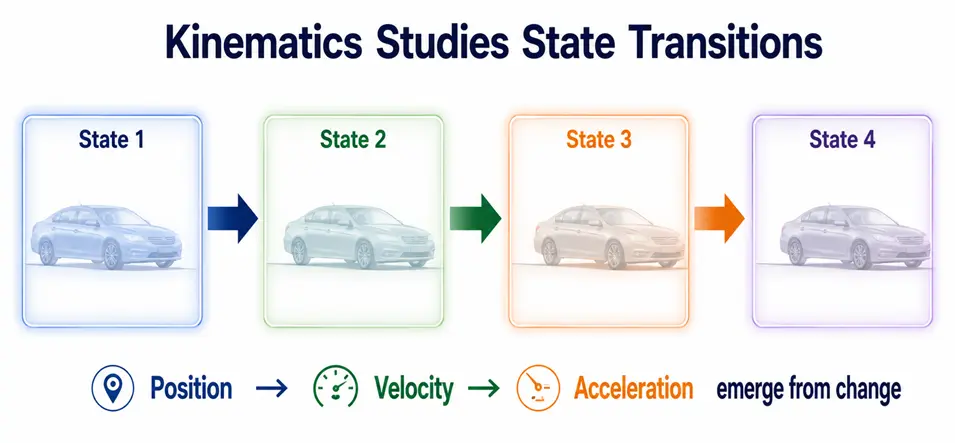
Motion is not a single snapshot.
It is a continuous journey from one state to another.
Kinematics studies how those states evolve with time.
Suppose you know that a car is currently at position 50 m.
Can you determine whether it is moving?
Can you tell whether it is speeding up or slowing down?
The answer is no.
A single value contains only a snapshot of reality.
Motion becomes meaningful only when we compare one state with another.
At any instant, a moving object possesses a state.
This state can be described by quantities such as position and velocity.
However, kinematics is not primarily concerned with individual states.
It studies how one state changes into another as time passes.
Velocity describes how position changes.
Acceleration describes how velocity changes.
Every major quantity in kinematics is fundamentally a measure of transition.
Motion therefore becomes a story of continuous evolution rather than isolated measurements.
Consider an object whose position is given by:
At:
This tells us only the object's state at one instant.
To understand motion, we compare states:
The change in position between these states reveals velocity.
Motion emerges from the transition, not from either state alone.
Nature is dynamic.
Physical systems are constantly evolving.
Kinematics captures this evolution by studying how one state transforms into the next.
Position, velocity, and acceleration are not isolated ideas.
They are connected stages in an ongoing chain of change.
Understanding motion means understanding transitions.