
2 min read
Imagine two friends starting from the same location.
Both eventually arrive at the same destination.
One takes a straight road.
The other follows a long winding route through several streets.
Clearly, the second friend travels a much greater distance.
Yet physics says both may have exactly the same displacement.
How can two journeys of very different lengths produce the same displacement?
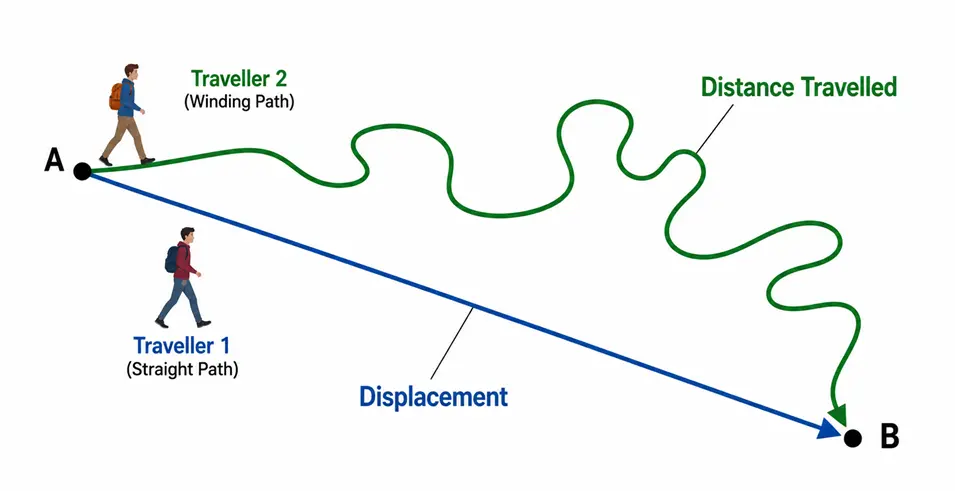
Distance depends on the actual path travelled.
Displacement depends only on where the journey begins and where it ends.
The route may change dramatically while the displacement remains identical.
Suppose your home is 1 km east of your school.
One day you walk directly from school to home.
Another day you take a longer route through nearby streets before reaching home.
The total distance travelled is different on the two days.
However, your starting point and ending point are unchanged.
Therefore your displacement remains the same.
Distance is the total length of the path travelled.
It depends on every turn, curve, and detour along the journey.
Displacement is different.
It is the straight-line change in position from the initial point to the final point.
Displacement ignores the details of the route.
It cares only about where the object started and where it finally arrived.
This is why many different journeys can produce the same displacement.
Consider two travellers moving from point A to point B.
Traveller 1 follows a straight path of:
Traveller 2 follows a winding route of:
However, the straight-line separation between A and B is:
for both travellers.
Their distances differ greatly.
Their displacements are identical.
Nature often distinguishes between a process and its outcome.
Distance describes the process—the actual journey.
Displacement describes the outcome—the net change in position.
Physics frequently focuses on displacement because it captures the overall effect of motion without being distracted by the details of the path.